If you’ve ever found yourself pausing mid-sentence, finger hovering over the keyboard, wondering whether a hyphen, en dash, or em dash is the right choice—congratulations! You’ve just joined the secret society of attentive writers.
These little marks may be small, but they pack a punch when it comes to clarity and style. Let’s demystify the differences and discover how to wield them with confidence (and maybe a little flair).
Meet the Trio
Let’s start by laying out our characters:
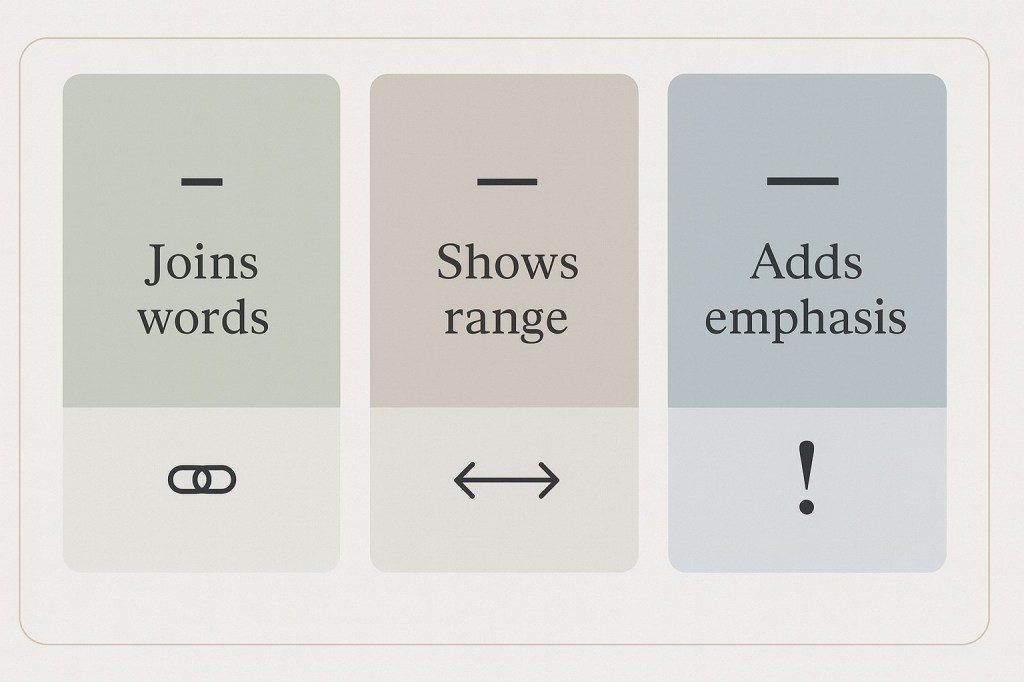
- Hyphen (-): The humble connector. Short and sweet, it ties words together like the glue of the punctuation world.
- En Dash (–): Slightly longer, the en dash is the diplomat—bridging gaps and showing ranges.
- Em Dash (—): The drama queen. Longest of the bunch, it commands attention and adds emphasis, often in place of commas or parentheses.
Don’t worry, you won’t be quizzed on their lengths (unless you’re entering a competition for punctuation marks).
The Hyphen: Small but Mighty
Hyphens are everywhere. They join two words to make a compound (think ‘well-written’ or ‘high-speed’), connect prefixes (like ‘ex-president’), and help avoid confusion (a ‘small-business owner’ is not the same as a ‘small business owner’).
Common uses:
- Compound adjectives before nouns: ‘state-of-the-art design’
- Numbers and fractions: ‘twenty-one’, ‘two-thirds’
- Certain prefixes and suffixes: ‘self-aware’, ‘anti-inflammatory’
Pro tip: If in doubt, check the dictionary. Some compounds are now so common they’ve lost their hyphens (’email’ used to be ‘e-mail’!). Language evolves, and so do hyphens.
The En Dash: The Great Connector
The en dash is a little longer than the hyphen. Its main job? Representing range. If you’re talking about numbers, dates, or pages, the en dash is your friend: ‘pages 10–15’, ‘Monday–Friday’, or ‘2010–2020’.
The en dash is a little longer than the hyphen. Its main job? Representing range. If you’re talking about numbers, dates, or pages, the en dash is your friend: ‘pages 10–15’, ‘Monday–Friday’, or ‘2010–2020’.
Other uses:
- Connecting related concepts: “the Nobel Prize–winning author”
- Scores: “The final was 4–2.”
How to type one:
- On Windows: Alt + 0150
- On Mac: Option + Hyphen
The Em Dash: The Drama Queen
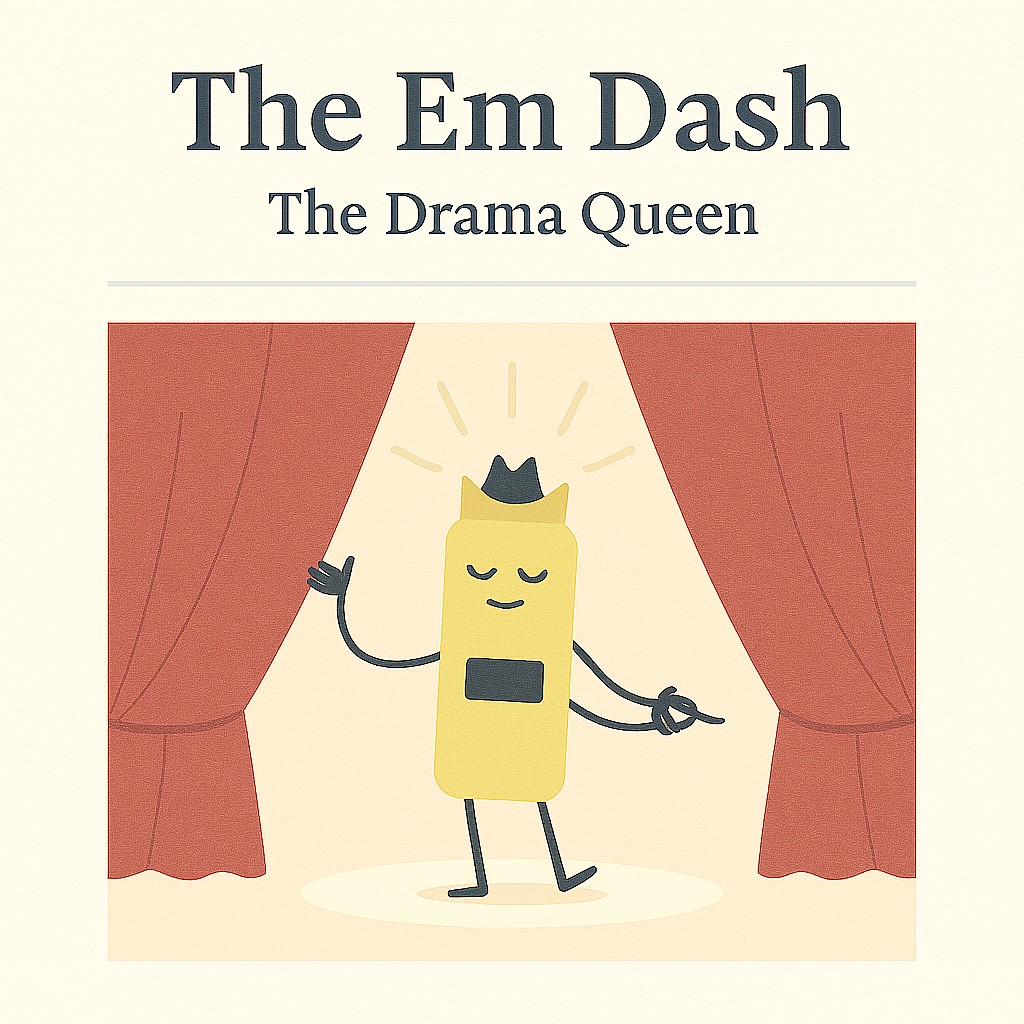
If the em dash had a motto, it would be: Make it stand out! It’s the longest of the three and is used to set off information—like this—or to indicate an abrupt change of thought.
If the em dash had a motto, it would be: Make it stand out! It’s the longest of the three and is used to set off information—like this—or to indicate an abrupt change of thought.
Common uses:
- To set off a phrase: “She was running late—again.”
- In place of parentheses: “My friend—the one with the crazy hat—showed up.”
- For emphasis or interruption: “Wait—did you hear that?”
How to type one:
- On Windows: Alt + 0151
- On Mac: Shift + Option + Hyphen
Why Does It Matter?
Using the right dash or hyphen makes your writing clearer and more professional. Plus, it signals to readers (and editors!) that you care about the little things. It’s like having polished shoes with your outfit—subtle, but it makes a difference.
Common Pitfalls (and how to dodge them)
- Overusing em dashes: They’re fun, but if every sentence is packed with them—well, things get messy.
- Missing hyphens in compounds: “High quality service” is a compliment; “high-quality service” is a standard.
- Hyphen instead of en dash: Don’t use a hyphen for ranges. ‘1990-2000’ should be ‘1990–2000’.
A Note on AI and Dashes
You may have heard a rumour that if your writing features a lot of dashes, it must be AI-generated. Don’t believe it! Humans have been using these marks for centuries. In fact, using them thoughtfully is the sign of a careful writer—not a robot.
Wrapping Up
Hyphens, en dashes, and em dashes may be small, but their impact is mighty. Use them with confidence, and your writing will glide along as smoothly as a well-oiled roller skate—dashingly done, if you will.
Need help fine-tuning your message? Reach out, and let’s make every word count (and every dash dazzle).
 Writing Solutions
Leave a comment